Monday, February 25, 2019

Kepa Arrizabalaga: Has $92.8 million goalkeeper fatally undermined Maurizio Sarri?

Kepa Arrizabalaga: Has $92.8 million goalkeeper fatally undermined Maurizio Sarri?


(CNN)Maurizio Sarri tore furiously at his jacket, gesticulating wildly as he stormed down the Wembley tunnel.
The Chelsea manager, already fighting for survival after just seven months in the job, had just been publicly humiliated in the biggest match of his career by an act of insubordination from one of his youngest players.
Having already gone down twice with cramp during extra time of the League Cup final, Kepa Arrizabalaga -- Chelsea's 24-year-old goalkeeper and the most expensive stopper in the world -- was set to be substituted and replaced by Willy Caballero.
    Upon seeing his number held up by the fourth official, Kepa -- a $92.8 million summer signing from Athletic Bilbao -- began defiantly wagging his finger towards Sarri on the touchline, refusing to leave the pitch.
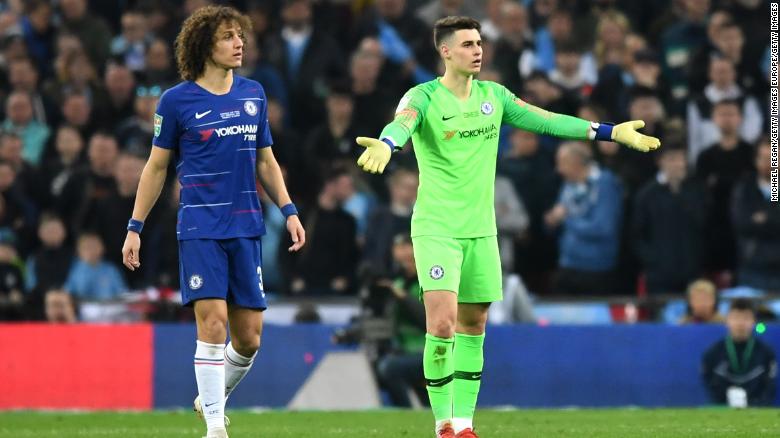
    Kepa looks towards the bench as Sarri demands his goalkeeper to leave the pitch.
    What followed was an ugly scene that overshadowed what was a markedly improved Chelsea performance and a battle of wills, embarrassingly lost by a manager in the first major cup final of his career.
    Substitute Caballero, who saved three penalties for Sunday's opponents Manchester City against Liverpool in the 2016 final, stood confused with his arms outstretched in the direction of his embattled boss.
    A visibly livid Sarri, who eventually backed down after a conversation with referee Jonathan Moss, had to be held back from confronting Kepa at full time by his defender Antonio Rudiger.
    The ugly standoff, which few can ever remember seeing previously in the sport, serves as yet more fuel for the accusations of "player power" in the Chelsea dressing room, which reportedly forced Antonio Conte and Jose Mourinho out of Stamford Bridge.
    For Sarri, now publicly undermined following weeks of speculation surrounding his future, the question is: What next?
    Does the Italian allow Kepa's act of disrespect to slide and select the goalkeeper for Wednesday's crucial Premier League derby against Tottenham?
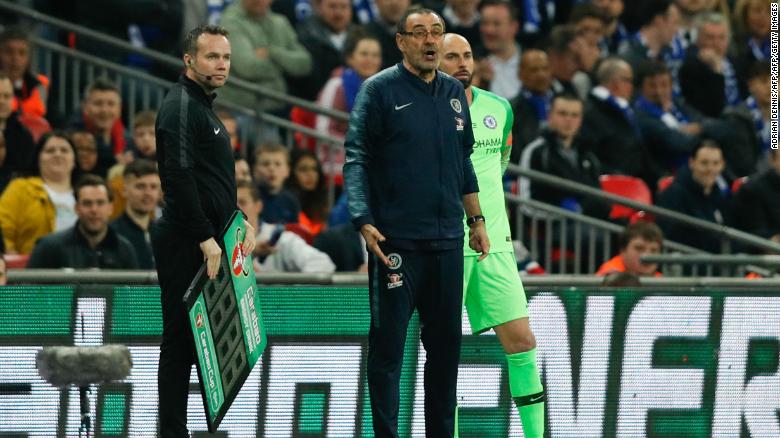
    Maurizio Sarri was visibly furious on the touchline, storming down the Wembley tunnel before deciding to return.
    In the post-match press conference, it seemed this was the route Sarri had decided to go down -- at least publicly.
    "It was a big misunderstanding," he told reporters. "I understood he had cramp so I didn't want the goalkeeper to go to penalties in that physical condition. I only realized the situation after three or four minutes when the doctor came to the bench.
    "In the meantime I wanted Caballero on the pitch, and the keeper [Kepa] only wanted me to know he was in condition to go to penalties, so it was a big misunderstanding.
    "Kepa was right, even if the way he conducted himself was wrong. Mentally he was right, he was able to go to penalties, but I only realized everything when the doctor was able to come to the bench, not before. I was really angry.
    "I want to talk with him because he needs to understand that with a misunderstanding we can get in trouble, especially with you (the media). So I think I only have to explain the situation to Kepa but without any other problem."
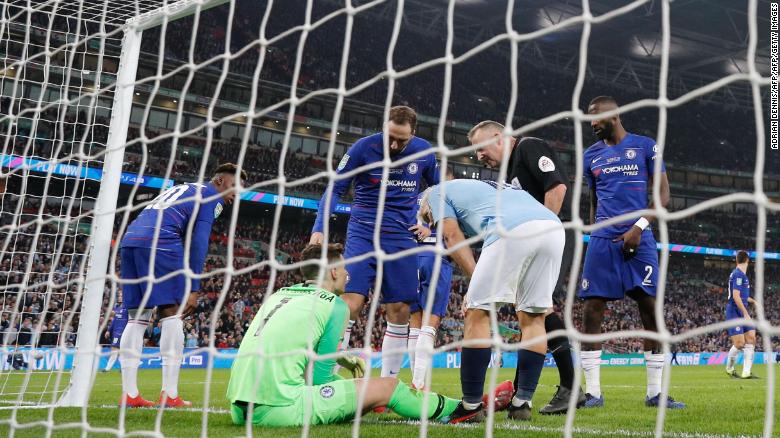
    Kepais treated for cramp on the pitch during extra time.
    Kepa, at least this time, went along with his manager and claimed the altercation was nothing more than confusion between the pair.
    "First of all, I have to say it was misunderstood," said the goalkeeper. "In no moment was it my intention to disobey, or anything like that with the boss.
    "Just that it was misunderstood, because I had been attended to by the medics twice, and he thought that I wasn't in condition to continue. It was two or three minutes of confusion until the medics got to the bench, and they explained everything well.
    "I know if you see it from outside, I don't know how it went out, it is not the best image. I have spoken with the boss. I think it was misunderstood. I understand that on television, on social media, they're talking about this but I am here to explain it, to say that it wasn't my intention to go against the manager."
    Their version of events didn't wash with those who had witnessed the standoff and whether or not Sarri will deal with Kepa differently in private is another question, but the blame also lies at the door of Chelsea's senior players who refused to stand up for their manager.
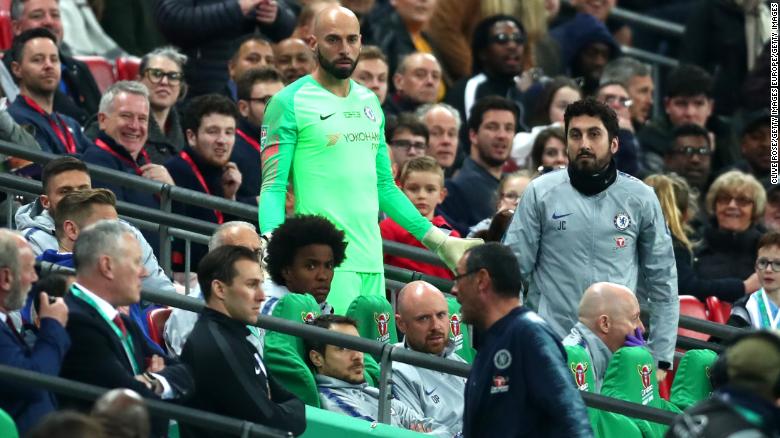
    A confused Willy Caballero looks towards Sarri on the bench.
    Captain Cesar Azpilicueta was nowhere to be seen, while David Luiz appeared to be having a mild-mannered private chat with the goalkeeper over the impasse.
    Another option Sarri has, and one which many onlookers believe he should take, would be to leave Kepa on the bench or in the reserves for the foreseeable future.
    However, for a manager whose job is on a knife edge following several abysmal performances, it seems unlikely Sarri holds the power to come out on top against the club's most valuable asset.
    Coupled with Chelsea's inability to sign a potential replacement for two transfer windows following a FIFA ban, Kepa's future at the club appears to be safe.
    Sarri's fury will have been compounded by the incident overshadowing arguably one of the team's best performances during his time in charge.
    After all, he had suffered a resounding 6-0 defeat at the hands of Pep Guardiola's City just two weeks earlier but in Sunday's final Chelsea had shown glimpses of Sarri's blueprint, the reason he was headhunted from Napoli.
    The team defended resolutely as a unit and there were neat combinations which allowed Chelsea to play out effectively from the back, bypassing City's high press.
    Jorginho recycled the ball efficiently in midfield, as he did for Sarri when the pair were in Naples, while N'Golo Kante was at times a devastating outlet for Chelsea to transition from defense to attack.
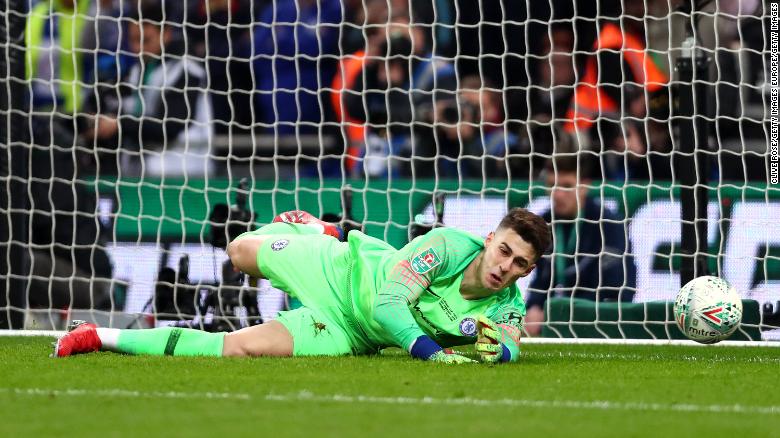
    Kepa allows Sergio Aguero's weak penalty to squirm under his hands.
    In truth, few would have argued had Chelsea come out on top after 120 minutes but now few will remember the match for anything other than Kepa's public display of disobedience.
    The Spaniard even had the chance to turn himself into a hero in the subsequent penalty shootout, but only infuriated his fans more by allowing Sergio Aguero's weak penalty to inexplicably squirm under his hands.
      He did go some way to making amends a few minutes later, saving Leroy Sane's effort, but misses from Luiz and Jorginho proved costly -- both for Chelsea and Kepa's reputation.
      It seems a shame that for 120 minutes the Chelsea players put in a performance which may well have saved Sarri's job, only for Kepa's public mutiny to put his coach's position in yet more danger.

      source : https://edition.cnn.com/2019/02/25/football/kepa-arrizabalaga-maurizio-sarri-carabao-cup-final-spt-intl/index.html

      Monday, March 31, 2014

      This could be our first look at the completely redesigned iPhone 6


      This could be our first look at the completely redesigned iPhone 6


      By Zach Epstein

      Whether you’re an iPhone fan, an Android fan, a Windows Phone fan or a BlackBerry fan, everyone can likely agree that Apple’s iPhone 6 will be the biggest smartphone launch of the year. Armed with just an “S” upgrade and a new plastic iPhone model that by all accounts has been a flop, Apple managed to sell a staggering 9 million new iPhones through the iPhone 5s and 5c’s first weekend of availability alone. Now, in 2014, Apple will reportedly have not one but two brand new iPhone models that sport a complete design overhaul and larger displays.

      And it looks like we may now finally have our first look at Apple’s new iPhone design for 2014.

      Following the leak of a purported case mold that third-party protective case designers might use to get an early jump on building cases for Apple’s next iPhone, a Japanese blog posted what it claimed to be schematics for both of Apple’s next-generation iPhones that were printed by a magazine in Japan. According to the leak, those devices included an iPhone 6 with a 4.7-inch display and a larger iPhone phablet with a 5.7-inch screen.

      Of note, earlier reports from several solid sources suggested that Apple’s new phablet will feature a 5.5-inch screen.

      The blog that posted the supposed schematics, Macotakara, has leaked accurate information about unreleased Apple devices numerous times in the past, so French Apple blog Nowhereelse.fr and graphic designer Martin Hajek decided to put together a series of 3D renders based on the leaked blueprint. The result may indeed be our first look at the new iPhone 6′s design, if the leaked dimensions and other details are accurate.

      Several images of the iPhone 6 render follow below (click for full size) along with the schematics that had leaked earlier.


      source: http://bgr.com/2014/03/31/iphone-6-leaked-pictures-rear-shell/

      Will companies like Oppo and OnePlus bring back the ‘wow’ factor to the smartphone market?

      oppo-find-7-aa-10

      Will companies like Oppo and OnePlus bring back the ‘wow’ factor to the smartphone market?

      In the last month we’ve seen the introduction of next-gen Android flagships from well-known Android manufacturers Sony, Samsung and HTC. Although all three devices offer solid specs and several other features that set them apart from their predecessors, we can’t help but feel that the “WOW” factor is missing.

      There are likely many reasons why a fair number of tech enthusiasts haven’t exactly been blown away by the latest flagship announcements. Probably one of the most obvious reasons is that we’ve come to expect so much from these brands, and therefore its harder to impress us than it was just a few years ago. It’s also hard to deny that the latest flagships feel more like incremental updates than massive leaps forward when compared to their predecessors.

      Based on some of the comments we’ve seen in regards to handsets from Chinese companies like Oppo and OnePlus, however, it seems that at least some of our readers have been quite impressed by what some of these lesser known Android players have been up to as of late. It’s true that OnePlus’ teasers have painted the device as a compelling offering, and the Oppo Find 7 equally looks amazing thanks to its QHD display and quick charging capabilities.

      In this week’s Friday Debate we ask the following questions: As thebig players are taking less risks and playing things a bit more safely, can newcomers like Oppo and OnePlus bring back the “WOW” factor to the smartphone market? Will increased competition from Chinese manufacturers help shake-up the market in any meaningful way?

      Join us in the discussion, vote in our poll, and sound off in the comments.

      Robert Triggs

      I certainly agree with the lack of a “wow” factor from all of the recently major releases. That isn’t to say that high-end smartphone aren’t great pieces of kit, rather the increase in the number of competitors and high-end handsets has resulted in smaller and smaller leaps between generators, if you can really define generations any more.

      Part of the “problem” is that technological differences are becoming smaller and smaller all the time. The leap from a Snapdragon 600 to 800 isn’t really that huge, especially compared with jump from single to dual core. Again, Full HD to QHD isn’t as pronounced as the arrival of 1080p.

      As for newer players like Oppo or OnePlus, they’re doing some interesting work, but I don’t think they’re really going to shake things up massively. The technology they’re using will eventually be available in other flagships in just a few months’ time. Perhaps their hardware will grab the attention of enthusiasts, but it probably won’t blow away the average consumer.

      The race to the middle is an interesting one, handsets like the HTC Desire 816 are really great looking products aimed just below the top tier. As production costs continue to come down, I’m sure that we’re likely to see some really nice looking mid-range products in the future. The Nokia X is also a showcase for what can be accomplished on a budget. Pressure on prices and technology is working out really nicely for consumers.

      The smartphone market has matured now, and this natural plateau has caused a noticeable loss of momentum, but we must remember how far smartphones have come in just a few years.

      There are technological innovations to look forward to. Leaps in areas like mobile gaming, smarter wearables, modular designs, and more seamlessly connected devices are yet to come, and I’m certainly looking forward to them all.

      Bogdan Petrovan

      I don’t blame Samsung, HTC, or Sony for playing it safe. They already invested hundreds of millions in developing great products, and they just can’t throw that away and start over every 12 to 18 months. Add some more millions for burning the shape of their devices onto our retinas, and the pressure to produce profits, and you see why there aren’t any bold devices coming out. Besides, the smartphone is a mature product – the time of growing in leaps and bounds is over, and we now face a period of stable growth or even plateauing. I just hope smartphones won’t have the fate of PCs, which all became “good enough”, and thus boring.

      Companies like OnePlus, Oppo, or Xiaomi can afford to be bold, because they have less to lose and because they have to be bold in order to set themselves apart. These young wolves are going after the throats of the old pack leader, and honestly I hope at least one of them makes it. The Oppo Find 7 is amazing in its ambition. It’s a beautiful piece of technology with the best specs around. I expect nothing less of the OnePlus One when it comes out next month. But do they deliver the wow that Samsung or HTC are missing? Not really.

      For something truly spectacular I look at Google. Project Ara or Project Tango are amazing examples of what you can do (or at least try to do) when you can take risks, knowing that you have the resources of the biggest technology company in the world. What really excites me though is Google’s ongoing effort to create a truly intelligent assistant and to make it available on every device in the world. When that happens, we will all be wowed.

      Jonathan Feist

      Does the OPPO Find 7 and OnePlus One bring “wow!” to the smartphone industry? Absolutely. Is that alone enough to change the Android market? Maybe not.

      I am strongly reminded of the automotive industry. The thing is, auto makers like Ferrari, Lamborghini, Bugatti and more bring “wow!”, and then some, to the roads, but the cars we take home are the comparatively boring Ford’s, Toyota’s etc.

      Before the argument of price of cars comes up, consider that one of the most “wow!” car makers out there, Tesla, sells their current model for the same price as a pickup truck or SUV. And trust me, pickups and SUVs do not wow like a Tesla!

      Back to the point, the best “wow!” features from supercars usually just end up silently making their way to the mainstream makers. I believe that this will be true of the Android market. We are destined to see great new features all blend together into future devices by the big players, but we’ll be less and less impressed by the devices themselves. Incremental growth is great, but boring.

      I love the new features that OPPO and OnePlus are bringing to the table, I hope that they develop into the supercars of the industry.

      Andrew Grush

      As at least a few of my co-workers know, I’m a big fan of the “little guy”, and that’s equally true when it comes to certain companies in the world of Android. I’m am particularly excited by Chinese companies like Oppo and OnePlus because they are working to bring us amazing features, high-end hardware, low-pricing and some of the ‘wow’ factor that I’m just not seeing from the bigger companies anymore.

      Don’t get me wrong, HTC, Sony and Samsung all have great hardware, they’re just not what I’m looking for personally (though Sony comes very close.. if pricing was just a bit lower!) For me, the main factors for choosing a smartphone include pricing/value, features and how close the handset is to stock. I don’t like the overload of software customizations we see particularly from HTC and Samsung, and I personally favor the Nexus line and own a Nexus 5.

      That said, if anyone could get me to move away from a Nexus handset, I think it’d be Oppo, OnePlus, Xiaomi, Meizu or even Vivo — especially if any of these brands end up embracing CyangenMod the way we’ve seen with the Oppo N1 CyanogenMod Edition and the upcoming OnePlus.

      Back to the real question though: will Chinese companies shake up the industry or really bring back the “wow” factor that (arguably) has been lost? No, they probably won’t. Sure, some tech geeks like myself will embrace these alternatives due to their underdog status, awesome specs and low price-points. You can also bet that many of these bleeding edge features we’re seeing from Chinese players will eventually roll out to established players like Samsung and HTC. But that’s about where the influence ends.

      Could this change eventually? Maybe. If Oppo and OnePlus keeps pushing hard, they could eventually become part of the ‘big boys club’. When they do, however, I imagine they will slow down when it comes to making bold moves and major design changes as well. Why? As Bodgan said so well, once you invest so much in creating your brand identity it’s hard to throw it all away in the hope that your changes will “wow” both your existing customers and new ones as well.

      source: http://www.androidauthority.com/oppo-oneplus-wow-362616/

      LG and Samsung gear up for the next bout of flexible display technology

      LG and Samsung gear up for the next bout of flexible display technology


      LG G Flex vs Samsung Galaxy Round Quick Look Hands on AA (3 of 11)
      Samsung and LG are on the cutting edge of what could become a popular future trend – curved and flexible display smartphones. The two companies have already released their first generation curved displays, the LG G Flex and the Samsung Galaxy Round. We conducted our own comparison between the two curved handsets at the end of last year. But where is the future of flexible displays heading?
      According to industry insiders, who recently spoke with ETNews, LG Display will be focusing on reducing the size of its flexible displays and improving various display aspects, such as resolution, this year. On the other hand, Samsung Display is said to be developing a variety of forms of flexible AMOLED, with the aim of making the design the game changer.
      LG G Flex vs Samsung Galaxy Round Quick Look Hands on AA (6 of 11)
      Looking at LG specifically, the company’s flexible display technology is currently suffering from poorer specifications that Samsung’s equivalent. Desipite the larger display size, the LG G Flex could only muster a 720p resolution and a pixel density of 245 ppi. Samsung’s Galaxy Round, on the other hand, managed a 1080p resolution, resulting in a pixel density of 386 ppi.
      LG AND SAMSUNG ARE EXPECTED TO UNVEIL NEW CURVED SMARTPHONE DESIGNS LATER THIS YEAR.
      This year, LG is planning to reduce the size of its flexible display down to 5.5 inches, whilst upping the resolution to FullHD (1080p). LG is also reportedly working to improve heating issues with its OLED design.
      “Our goal is to enhance product performance a notch or higher across the board.” LG insider
      An interesting point to note is that Samsung’s AMOLED display found in the Galaxy Round isn’t actually “flexible” in the same sense as LG’s, which might explain why Samsung’s technology retains familiar specifications. As a result, Samsung’s future plans are quite different. Samsung is said to be experimenting with various curved designs, in both the horizontal and vertical planes, as well as designs involving curved edges.
      samsung fit black orange smartwatches aa 9
      Whilst LG focuses on improving its existing flexible display technology, Samsung is testing out a wider range of designs and uses.
      According to industry insiders, Samsung Display has decided to develop a product incorporating various types of curvature, which should be making its way into a future smartphone. Samsung believes that it will be the design that will determine the success or failure of its flexible AMOLED technology.
      Both LG and Samsung are expected to unveil new curved smartphone designs later this year.
      But hold on, we’re not close to this being a widespread technology, not yet at least. According to research firm IHS, LG Display and Samsung Display’s flexible AMOLED production capacity reached 20,000 sheets per month last year, from various production lines and display sizes. There’s no chance that current production yields could keep-up if the technology was to be used in a flagship smartphone. Low yields, high prices, and other component development costs are still limiting the production of units and availability for use in products.
      “For the time being, flexible displays will not be found on smartphones very often.” Kang Min-soo, IHS Researcher
      The other half of the issue is whether or not consumers really care about curved displays. Despite being able to output around 240,000 sheets per year, Samsung and LG have only managed combined sales of less than 100,000 curved displays so far. This figure includes a range of technologies, including TVs. Perhaps new smartphones or wearables could help boost these sales figures, but for the time being flexible and curved displays will probably remain a niche.
      Do you think that curved and flexible designs are the future for smartphones or wearables, or have you been unimpressed with this first generation of products?
      source : http://www.androidauthority.com/lg-samsung-next-gen-flexible-displays-362956/

      Microsoft Office for Android review

      Microsoft Office for Android review


      Microsoft Office for Android was first released in late Summer 2013. Unfortunately it required an Office 365 subscription to even use and that turned a lot of people off to the idea of using Microsoft’s venerable Office on their devices. A couple of weeks ago the app became free to use for Android device owners and interest in Microsoft on Android skyrocketed for the first time probably ever. So in this review, we’ll see if it’s an office app worth your time. As usual you can watch it above or read it below.

      Microsoft Office for Android review

      Functionality

      Okay so there’s very little about Microsoft Office that you don’t already know. You know about Microsoft Word, Spreadsheet, and PowerPoint, what they do, and how they work. So thankfully this part of the review won’t take very long. As you can imagine, the mobile version of Office contains these three things and you can use them to create and edit documents, presentations, and spreadsheets.
      When creating and editing, you have the basic tools like editing and control. You can use some basic formatting should you need it. It’s not nearly as powerful as the desktop apps or the Office 365 web apps. That’s a shame and we hope they increase functionality eventually but aside from some tweaks here and there it’s going be difficult to prepare full featured documents and presentations on the mobile version.
      It’s fairly simple and that’s about all the app does in terms of pure functionality. However, there is more going on under the hood. Using Microsoft Office requires a Microsoft account. Once you have that you’ll automatically get some storage for Microsoft’s OneDrive service which you may know by its prior name which SkyDrive.
      Currently you get 7GB for free and there’s a promotion for now that gives you an extra 3GB if you download the OneDrive app and use it to upload your photos from your Android device.
      Everything you do in the Microsoft Office app is saved and drawn from your OneDrive account much like how every document you make in Google Drive is also stored in Google Drive. There is very little difference between the two fundamentally and for that, Microsoft does deserve a little praise.


      Microsoft Office for Android review 2

      Design

      In terms of design, Office actually looks pretty good. Moving around the app is simple so no one should be getting lost. It uses some of the Android design guidelines such as the swiping tabs and using the logo at the top to go back to previous pages. Inside the files, it’s easy to navigate around your documents.
      It saves every file to OneDrive so you can’t really go surfing around your device storage so don’t plan on being able to do that. The interface is overall very simplistic and the controls in apps are pretty simplistic too. Really, nothing is too difficult.
      That doesn’t mean it isn’t tedious. In order to get the full experience, you’ll have to download the OneDrive app as well. That’s really the only good way to navigate your OneDrive account. When you open documents in OneDrive, it’ll open in Microsoft Office but the Office app doesn’t surf the OneDrive account very well. That, we thought, was a poor design choice.

      Microsoft Office for Android 3

      The good

      So here’s what we liked about Office
      • It’s Microsoft actually giving it the old college try. Their first attempt at an Office app was not the most popular option and it didn’t work all that well. Now that it’s free and it’s been overhauled and integrated with OneDrive, it is suddenly much better than it used to be.
      • One of the biggest complaints about non-Microsoft Office apps is how it wrecks the formatting of Microsoft Office documents. That should no longer be a problem.
      • You are forced to use OneDrive for your storage for this app and that sucks, but they give you 7GB free so it’s not all that bad. You can get 3GB more for a limited time by downloading the OneDrive app and giving it permission to upload your camera stuff. So you can start with 10GB and even though Google Drive gives you more, at least Microsoft doesn’t leave you in the dirt in terms of cloud storage.
      • Full integration with OneDrive means that if you download the OneDrive app on your PC and have an internet connection, you have full control over the documents on both platforms without any difficulty. Office on mobile can open any document in OneDrive as can the PC Office app as well as the Office 365 web app. Multi-platform integration is never bad. Ever.
      • Lastly, the design isn’t terrible. Microsoft has developed some questionable mobile apps for Android in the past and this does not fall into that category. It doesn’t follow all of the Android design suggestions, but it follows a few of them and the app design positively reflects that.

      The bad

      And here’s what we didn’t like so much.
      • We would’ve liked to see more formatting tools. You can do the basic stuff like bold, underline, italics, color, and size, but things like adding images, advanced formatting, and others aren’t present and that’s disappointing.
      • Integration with OneDrive is fantastic and I love that, but knowing when to use which app for which purposes is a little hard to get used to. Like if you need to open a document, you’ll find it easier in OneDrive rather than the Office app and that’s disorienting. Also, your only storage option is OneDrive although you can download files from OneDrive if you have to.
      • Despite the good design, the controls are a little tedious. When you open a document, you have to click the pencil icon at the top in order to edit it. That extra step kind of screws with the brain because you’re kinda used to just opening the document and go. That, along with the way the app lets you see formatting options can be tedious and even a little frustrating.

      Microsoft Office for Android review 4

      Final thoughts

      Here’s the bottom line with Microsoft Office mobile. It’s a lot better than I was expecting it to be. Given prior experiences with Microsoft applications, there wasn’t that expectation that this would be directly comparable to the best Android has to offer. As it turns out, it is directly comparable and Microsoft has a pretty good app here.
      That said, you won’t be concocting epic documents with this app. You can edit them and create some basic stuff but the hard work will still have to be done on either the web app or the desktop app. In any case, if you’re an Office user and you have Android, I highly recommend you check this app out.

      source: http://www.androidauthority.com/microsoft-office-android-review-363150/

      Tuesday, March 18, 2014

      MISSING MH370: 'Terrain masking is possible'

      MISSING MH370: 'Terrain masking is possible'

      DARING MANOEUVRE: Trick is to know the location of radar, its range and terrain, say experts

      PILOTS are trained to safely fly aircraft in low altitudes and able to perform "terrain masking" at night if they have the data of the terrain or topography map of the area.
      Several former military pilots, who turn commercial airlines pilots after retirement from service, agreed with the New Straits Times' exclusive front page report yesterday that investigators were looking at the possibility of the missing Malaysia Airlines flight MH370 dropping to an altitude of 5,000 feet during most of eight hours it was missing from the radar coverage of possibly at least three countries.
      "A plane is very similar to a car. It can fly anywhere the pilot wants it to go. There is nothing to stop it as long as the pilot is daring enough," said a pilot, who spoke on condition of anonymity.
      "Terrain masking" is a means of avoiding active radar by positioning the aircraft so that there is natural earth hiding it from the radio waves sent by the radar system. This technique is used by military pilots to fly to their target stealthily, using the topography to mask their approach from prying radar microwaves.
      This type of flying is considered very dangerous, especially in low-light conditions and spatial disorientation, and airsickness could easily set in. The stresses and loads it puts on the airframe, especially of Boeing 777-200ER's size, are tremendous.
      "The pilot only needs to come up with a flight path within the limit and ability of the aircraft," said the former military transport aircraft pilot.
      He said any aircraft could be flown low as long as the pilot was able to control it.
      "Terrain masking is possible."
      Another pilot, who also spoke on condition of anonymity, said flying in low altitude at night was possible if the pilot was well-planned.
      "To plan on the right altitude to take, a pilot only needs to know the highest peak, obstacles or terrains along his flight path and add another 1,500 feet to it for safety.
      "In the northern peninsular, there are two peaks to be avoided -- Gunung Tahan (2,286m) and Gunung Bintang (1,828m) in Pahang.
      "So, to fly around the peninsular, a pilot needs only to maintain the aircraft's altitude at 9,000 feet and you can fly safely, even at night."
      As modern aircraft are equipped with the latest technology, he said, the pilot simply keyed in his target destination to create waypoints to be followed.
      "Just punch in the coordinates into the flight management computers, then research for the obstacles to avoid, what altitude to fly at each waypoint, use the altimeter and a pilot can easily fly at night."
      However, he said, it took skills and guts as no commercial airline pilot would attempt to fly below 5,000 feet at night without advanced planning.
      "At night, there are no visuals to guide you, so you do not know what it is in front of you."
      He said there were two ways to avoid detection: to hide behind an obstacle or to fly under the radar.
      "So, if a plane flies low at a location far from the radar station, it will not be detected.
      "The trick is to know the location of the radar, its range and the terrain. Once you have this information, any daring pilot, not just those who are military-trained, can fly without detection."
      United States Aero Consulting Experts chief executive officer Captain Ross Aimer told the New Straits Times that airlines pilots were trained to fly in low altitudes, adding that Boeing 777-200ER was a stable and easy aircraft to fly, both in low or high altitudes.
      The retired United Airlines captain said the pilot had to be familiar with the terrain and topography to perform the manoeuvre.
      "A low-range radio altimeter and onboard group mapping radar provide additional terrain clearance awareness for such manoeuvres.
      "Therefore, most average airline pilots can safely perform this type of flying with relative ease."
      Universiti Kuala Lumpur Malaysian Institute of Aviation Technology principal specialist Ahmad Maulan Bardai said if the Boeing 777 went below commercial radar, the pilot would have undergone "special training".
      "It is possible to perform terrain masking with the Boeing 777, but it is very challenging as the plane's configurations need to be changed accordingly to match the terrain."
      United States crew members onboard a P-8A Poseidon aircraft searching for the missing MAS flight MH370 in the Indian Ocean on Sunday. AP pic


      source MISSING MH370: 'Terrain masking is possible' - General - New Straits Times http://www.nst.com.my/nation/general/font-color-red-missing-mh370-font-terrain-masking-is-possible-1.518383#ixzz2wKNtUCph

      Scrutiny of MH370 pilots reveals picture of normality

      Peter Chong holds up his smartphone to show a photo of himself with missing Malaysia Airlines Flight MH370 captain Zaharie Ahmad Shah at a hotel in Sepang March 18, 2014. — Reuters pic

      Scrutiny of MH370 pilots reveals picture of normality - 

      KUALA LUMPUR, March 18 — One is a technical wizard whose affable manner made him a favourite of trainee pilots; the other an enthusiastic young aviator planning to marry his sweetheart.

      The captain and co-pilot of Malaysia Airlines Flight MH370 are now at the centre of a baffling paradox: as circumstantial evidence mounts that at least one of them may have been involved in the plane’s disappearance on March 8, accounts of their lives portray them as sociable, well-balanced and happy.

      Described as devoted to their families and communities, neither fits the profile of a loner or extremist who might have a motive for suicide, hijacking or terrorism.

      International media scrutiny and investigations by the Malaysian police have failed to turn up red flags on either the captain, 53-year-old grandfather Zaharie Ahmad Shah, or the co-pilot, 27-year old Fariq Abdul Hamid.

      Both live in well-to-do neighbourhoods in Shah Alam, an area west of Kuala Lumpur that is popular among flight crews for its proximity to the international airport. Today, security guards prevented reporters from entering Zaharie’s upscale gated residence. About 10 minutes’ drive away, Fariq’s house stood empty, with an unread newspaper lying outside.

      Family and friends say there is nothing in their personalities or past to suggest they would have committed foul play.


      “I’ve never seen him lose his temper. It’s difficult to believe any of the speculation made against him,” said Peter Chong, a friend of Zaharie, describing him as highly disciplined and conscientious.
      Eleven days after the Boeing 777 jetliner carrying 239 people vanished without trace, scrutiny has zeroed in on the pilots due to the deliberate way in which the plane was switched into radar darkness and diverted far from its route to Beijing.
      The person who chose that exact time and place to vanish appears to have acted only after meticulous planning and must have had advanced aviation knowledge, according to experts.
      “It raises so many questions, not least that you have got to be prepared to believe that a pilot would do this,” said Paul Hayes, a leading air safety expert at UK-based consultancy, Flightglobal Ascend.
      “But it is hard to understand the motive. In cases where pilot suicide was thought to be the cause, the alleged suicide pilots executed the plan as soon as they were in a position to do so.”
      A handyman with political passions
      Lacking other explanations, focus has turned to what would otherwise be seen as innocent passions in Zaharie’s life — a desire to vote out Malaysia’s long-ruling government, and an extreme enthusiasm for flying planes and fixing gadgets.
      Zaharie, a balding father of three who likes to cook, appears to have undergone a social-media awakening in early 2013 when he began posting video of himself on YouTube, dispensing tips on how to fix refrigerators and tweak air conditioners.
      After signing up to YouTube in January 2013, the man described by friends as a moderate Muslim watched clips on God and atheism and speeches by Malaysian opposition leader Anwar Ibrahim. He joined Anwar’s party the same month, and helped campaign for elections in May 2013 that were narrowly won by the ruling coalition and afterwards disputed by the opposition.
      “There is a rebel in each and everyone of us...let it out!” Zaharie wrote on Facebook in the weeks after the election as Anwar led nationwide rallies to challenge the result.
      About six hours before Flight MH370 took off, Anwar was convicted and sentenced to five years’ jail for sodomy, a ruling widely condemned as politically motivated.
      That has sparked speculation that Zaharie, perhaps enraged by the setback for his political idol, could have brought down the plane as a form of protest or out of despair
      But his passion to see Malaysia’s first change of government in 56 years was shared by millions in the country and the opposition is a democratic movement with no links to extremist groups. There is no evidence he attended Anwar’s trial, as some media reported. He still lived with his wife, despite other reports they were breaking up.
      “He was a disciplined person,” said Chong, who said he first met Zaharie two years ago when he saw him tidying chairs after a community event.
      “Since 9/11, I believe they are not even allowed to open the cockpit door even under duress. The captain Zaharie that I know would be the kind of person who would strictly stick to that.”
      Zaharie made no secret of his obsession with aviation, which ranged from flying model aeroplanes to setting up a multi-screen flight simulator at home, which he also showed off on YouTube. Police have seized the machine and are examining its contents, but say they have yet to find anything suspicious.
      A fellow Malaysia Airlines pilot, who declined to be identified, described Zaharie as a “decent and approachable man” who was sought out by less experienced pilots to observe their final training runs, a procedure known as line checks.
      “Younger pilots would seek him for their line checks because he was easy to talk to,” the pilot said.
      Neighbours who know Fariq, the son of a senior civil servant, told Reuters he is known as a good and pious man who was a regular worshipper at a mosque a few minutes walk from his house. Relatives said he was a diligent student who loved his job, having recently qualified to fly the wide-body 777 jet.
      There has been no suggestion he had extremist views or serious personal problems, although he came under fire after the plane’s disappearance when it emerged he had allowed two women into the cockpit on a 2011 flight.
      Fariq, who officials believe uttered the final words “all right, goodnight” from the cockpit, had been expected to propose this year to his girlfriend Nadira Ramli, who was a co-pilot for budget carrier AirAsia.
      “It was a matter of time before they got married,” said a relative of the fresh-faced Fariq who asked not to be identified. “Police investigating the suicide theory is upsetting to the family. Why would he even do that? He had a good life and he had Nadira.” — Reuters
      - See more at: http://www.themalaymailonline.com/malaysia/article/scrutiny-of-mh370-pilots-reveals-picture-of-normality#sthash.j9rPZPN6.dpuf

      Search Anything